Space weather: aurora, solar flares and geomagnetic storms
Now: R0 S0 G0
Space weather is quiet right now. No geomagnetic storm expected in the next 3 days (highest Kp 4-).
Kp now
2
Quiet.
Estimated for the 3 hours from . Kp runs 0 to 9; 5 and up is a storm.
Next 3 days
4-
No storm expected.
Highest Kp in NOAA's forecast, around .
Solar flares
B4.7
Biggest flare in the past 24 hours, below blackout level.
X-rays now: B1.4. Classes go A, B, C, M, X; each step is 10 times stronger. M1 and up blocks some shortwave radio.
Solar wind
316 km/s
Calm, normal speed.
Density 1.3 per cm³. Measured about a million miles toward the sun (SOLAR1), . Normal is about 300 to 400 km/s.
Kp index: past 3 days and next 3 days
Quiet (Kp 0 to 3) Active (Kp 4) Storm (Kp 5 and up) Lighter bars: estimated or NOAA's forecast Days in UTC
NOAA's 3-day forecast
| Tue Nov 24 | Wed Nov 25 | Thu Nov 26 | |
|---|---|---|---|
| Geomagnetic storm (G) | G0 None | G0 None | G0 None |
| Radio blackout R1 to R2 (M flares) | 1% | 1% | 1% |
| Radio blackout R3 or more (X flares) | 1% | 1% | 1% |
| Radiation storm S1 or more | 1% | 1% | 1% |
NOAA's 3-day forecast: the storm level expected each day (UTC) and the chance of a flare or radiation storm.
Aurora (northern lights) forecast
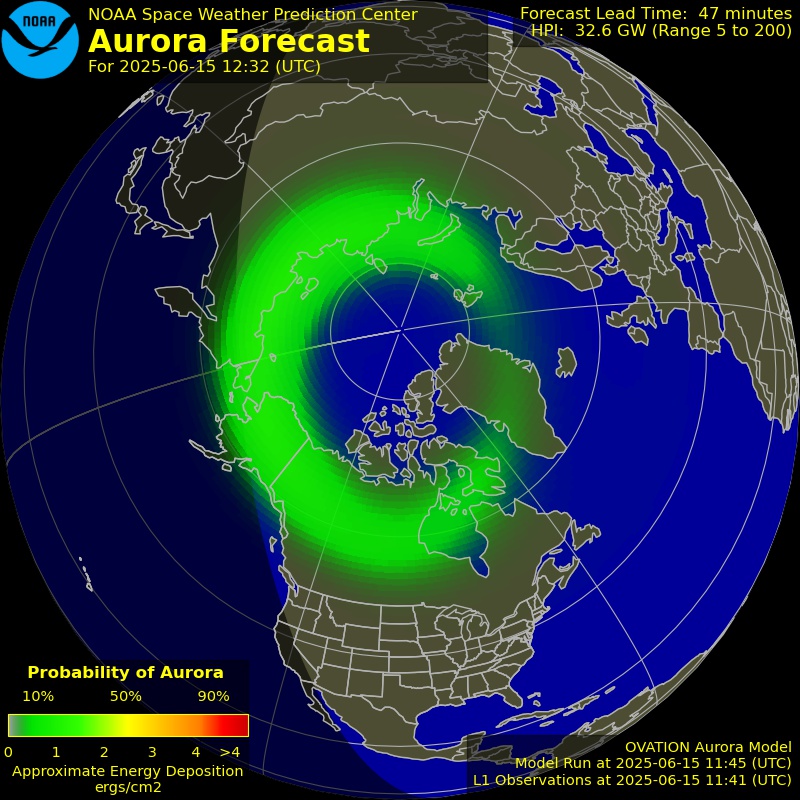
Little or no chance of aurora overhead in the lower 48 right now. The aurora can often be seen low on the northern horizon from a few hundred miles south of where the map shows color, on a dark, clear night away from city lights.
NOAA's 30 to 90 minute OVATION forecast, for . Green is a low chance, red a high chance of aurora overhead.
NOAA space weather alerts
Extended warning: Geomagnetic K-index of 4 expected
Space Weather Message Code: WARK04
Serial Number: 5457
Issue Time: 2026 Nov 19 0118 UTC

EXTENDED WARNING: Geomagnetic K-index of 4 expected
Extension to Serial Number: 5456
Valid From: 2026 Nov 19 0040 UTC
Now Valid Until: 2026 Nov 19 0900 UTC
Warning Condition: Persistence


NOAA Space Weather Scale descriptions can be found at
www.swpc.noaa.gov/noaa-scales-explanation

Potential Impacts: Area of impact primarily poleward of 65 degrees Geomagnetic Latitude.
Induced Currents - Weak power grid fluctuations can occur.
Aurora - Aurora may be visible at high latitudes such as Canada and Alaska.
Alert: Geomagnetic K-index of 5
Space Weather Message Code: ALTK05
Serial Number: 2063
Issue Time: 2026 Nov 19 0108 UTC

ALERT: Geomagnetic K-index of 5
Threshold Reached: 2026 Nov 19 0105 UTC
Synoptic Period: 0000-0300
Active Warning: YES
Noaa Scale: G1 - Minor
Comment:

NOAA Scale: G1 - Minor

NOAA Space Weather Scale descriptions can be found at
www.swpc.noaa.gov/noaa-scales-explanation

Potential Impacts: Area of impact primarily poleward of 60 degrees Geomagnetic Latitude.
Induced Currents - Weak power grid fluctuations can occur.
Spacecraft - Minor impact on satellite operations possible.
Aurora - Aurora may be visible at high latitudes, i.e., northern tier of the U.S. such as northern Michigan and Maine.
Warning: Geomagnetic K-index of 5 expected
Space Weather Message Code: WARK05
Serial Number: 2276
Issue Time: 2026 Nov 19 0100 UTC

WARNING: Geomagnetic K-index of 5 expected
Valid From: 2026 Nov 19 0055 UTC
Valid To: 2026 Nov 19 0300 UTC
Warning Conditions: Onset
Noaa Scale: G1 - Minor
Comment:

NOAA Scale: G1 - Minor

NOAA Space Weather Scale descriptions can be found at
www.swpc.noaa.gov/noaa-scales-explanation

Potential Impacts: Area of impact primarily poleward of 60 degrees Geomagnetic Latitude.
Induced Currents - Weak power grid fluctuations can occur.
Spacecraft - Minor impact on satellite operations possible.
Aurora - Aurora may be visible at high latitudes, i.e., northern tier of the U.S. such as northern Michigan and Maine.
Alert: Geomagnetic K-index of 4
Space Weather Message Code: ALTK04
Serial Number: 2698
Issue Time: 2026 Nov 19 0046 UTC

ALERT: Geomagnetic K-index of 4
Threshold Reached: 2026 Nov 19 0042 UTC
Synoptic Period: 0000-0300
Active Warning: YES
Comment:

NOAA Space Weather Scale descriptions can be found at
www.swpc.noaa.gov/noaa-scales-explanation

Potential Impacts: Area of impact primarily poleward of 65 degrees Geomagnetic Latitude.
Induced Currents - Weak power grid fluctuations can occur.
Aurora - Aurora may be visible at high latitudes such as Canada and Alaska.
Warning: Geomagnetic K-index of 4 expected
Space Weather Message Code: WARK04
Serial Number: 5456
Issue Time: 2026 Nov 19 0041 UTC

WARNING: Geomagnetic K-index of 4 expected
Valid From: 2026 Nov 19 0040 UTC
Valid To: 2026 Nov 19 0300 UTC
Warning Conditions: Onset
Comment:

NOAA Space Weather Scale descriptions can be found at
www.swpc.noaa.gov/noaa-scales-explanation

Potential Impacts: Area of impact primarily poleward of 65 degrees Geomagnetic Latitude.
Induced Currents - Weak power grid fluctuations can occur.
Aurora - Aurora may be visible at high latitudes such as Canada and Alaska.
Extended warning: Geomagnetic K-index of 4 expected
Space Weather Message Code: WARK04
Serial Number: 5455
Issue Time: 2026 Nov 18 1432 UTC

EXTENDED WARNING: Geomagnetic K-index of 4 expected
Extension to Serial Number: 5454
Valid From: 2026 Nov 18 0555 UTC
Now Valid Until: 2026 Nov 18 1800 UTC
Warning Condition: Persistence


NOAA Space Weather Scale descriptions can be found at
www.swpc.noaa.gov/noaa-scales-explanation

Potential Impacts: Area of impact primarily poleward of 65 degrees Geomagnetic Latitude.
Induced Currents - Weak power grid fluctuations can occur.
Aurora - Aurora may be visible at high latitudes such as Canada and Alaska.
Warning: Geomagnetic K-index of 4 expected
Space Weather Message Code: WARK04
Serial Number: 5454
Issue Time: 2026 Nov 18 0556 UTC

WARNING: Geomagnetic K-index of 4 expected
Valid From: 2026 Nov 18 0555 UTC
Valid To: 2026 Nov 18 1500 UTC
Warning Conditions: Onset
Comment:

NOAA Space Weather Scale descriptions can be found at
www.swpc.noaa.gov/noaa-scales-explanation

Potential Impacts: Area of impact primarily poleward of 65 degrees Geomagnetic Latitude.
Induced Currents - Weak power grid fluctuations can occur.
Aurora - Aurora may be visible at high latitudes such as Canada and Alaska.
Continued alert: Electron 2MeV Integral Flux exceeded 1,000pfu
Space Weather Message Code: ALTEF3
Serial Number: 3778
Issue Time: 2026 Nov 17 0848 UTC

CONTINUED ALERT: Electron 2MeV Integral Flux exceeded 1,000pfu
Continuation of Serial Number: 3777
Begin Time: 2026 Nov 08 2245 UTC

Yesterday Maximum 2MeV Flux: 4744 pfu
Max time: 2026 Nov 16 1500 UTC
How bad can it get?
Geomagnetic storms (G1 to G5)
Disturbances of Earth's magnetic field. They bring the aurora and can affect power grids, GPS and satellites.
| Level | What it can do | How often |
|---|---|---|
| G1 Minor | Weak power grid swings. Aurora seen at high latitudes, such as northern Michigan and Maine. | about 1,700 times (900 days) |
| G2 Moderate | Voltage alarms on high-latitude power systems. Aurora as low as New York and Idaho. | about 600 times (360 days) |
| G3 Strong | Power grid corrections may be needed. GPS and radio problems on and off. Aurora as low as Illinois and Oregon. | about 200 times (130 days) |
| G4 Severe | Possible widespread voltage problems. GPS degraded for hours. Aurora as low as Alabama and northern California. | about 100 times (60 days) |
| G5 Extreme | Widespread power grid problems; some grids may fail. HF radio out for 1 to 2 days. Aurora as low as Florida and south Texas. | about 4 times (4 days) |
Radio blackouts (R1 to R5)
Solar flares. They briefly block shortwave (HF) radio on the side of Earth facing the sun.
| Level | What it can do | How often |
|---|---|---|
| R1 Minor M1 flare | Weak, short loss of HF radio on the sunlit side. | about 2,000 times (950 days) |
| R2 Moderate M5 flare | HF radio blackout for tens of minutes on the sunlit side. | about 350 times (300 days) |
| R3 Strong X1 flare | Wide HF radio blackout for about an hour on the sunlit side. | about 175 times (140 days) |
| R4 Severe X10 flare | HF radio out on most of the sunlit side for 1 to 2 hours. GPS errors. | about 8 times (8 days) |
| R5 Extreme X20 flare | HF radio out on the whole sunlit side for hours. | less than once |
Solar radiation storms (S1 to S5)
Fast particles from the sun. They matter for astronauts, satellites and polar flights, not for people on the ground.
| Level | What it can do | How often |
|---|---|---|
| S1 Minor | Minor effect on HF radio in the polar regions. | about 50 times |
| S2 Moderate | Small radiation dose possible on high-latitude flights. | about 25 times |
| S3 Strong | Radiation risk for astronauts on spacewalks; more dose on polar flights. | about 10 times |
| S4 Severe | Satellite trouble; radio out in polar regions for days. | about 3 times |
| S5 Extreme | Satellites may be damaged; HF radio out in the polar regions for days. | less than once |
How often: per 11-year sunspot cycle, from NOAA's Space Weather Scales. The sun is near the busy part of its cycle in 2024 to 2026.
Space weather data: NOAA Space Weather Prediction Center (public domain): planetary Kp, 3-day forecast and scales, GOES X-rays, real-time solar wind, OVATION aurora model and alerts. Explanations by AtmosDays. AtmosDays is not affiliated with NOAA. swpc.noaa.gov